Jump testing
Comparing Squat Jumps, Countermovement jumps, and Countermovement with Armswing Jumps
Comparing the Squat Jump (SJ), Countermovement Jump (CMJ), and arm-swing CMJ (ACMJ) quantifies an athlete's ability to utilise elastic energy and whole-body coordination during explosive movement.
The difference between:
- SJ and CMJ height, often termed the "CMJ deficit", reflects how effectively the muscle-tendon unit stores and releases elastic energy. A larger difference indicates greater utilisation of the stretch-shortening cycle, whereas a smaller difference suggests a dominance towards contractile capacity of the leg muscles.
- Incorporating arm swing (ACMJ) introduces an additional coordinative component. Athletes who show greater improvements with arm swing typically demonstrate superior whole-body coordination and proximal-to-distal sequencing.
Collectively, these three tests create a power profile that enables coaches to differentiate between strength, elastic, and coordinative contributions to jump performance.
The table below outlines the relevance of each jump type across different sports. It should be interpreted with caution, as although certain sports may rely more heavily on specific jump qualities, improvements across all measures are likely to enhance overall performance.
The jumps are ranked: 1–10 with 1 having little relevance and 10 having significant relevance.
| Sport | SJ | CMJ | ACMJ |
|---|---|---|---|
| American Football | 8 | 9 | 8 |
| Rugby | 8 | 9 | 8 |
| Football | 6 | 9 | 10 |
| Swimming | 7 | 5 | 7 |
| Tennis | 5 | 8 | 9 |
| Running | 3 | 6 | 4 |
| Cycling | 6 | 7 | 2 |
| Sprinting | 8 | 10 | 9 |
| Mountain Biking | 9 | 8 | 3 |
| Gymnastics | 8 | 10 | 10 |
| Mixed Martial Arts | 7 | 10 | 9 |
Squat jump
The squat jump (SJ) is a measure of pure concentric lower-body strength and power, where the athlete:
- begins the jump in a squat position, typically a fixed knee angle of 90 degrees,
- pauses to eliminate any elastic energy (or bounce),
- then explodes upward
In a standard, protocol-correct squat jump, arms are fixed, typically with hands on hips or arms crossed over the chest.
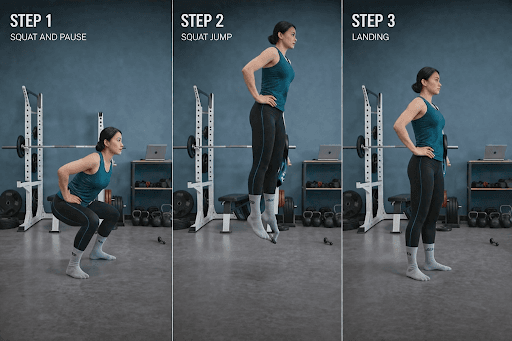
The SJ technique isolates the contractile function of the leg muscles by removing any preceding countermovement, primarily the quadriceps, glutes, and calves, and minimising elastic contribution from the stretch-shortening cycle. Monitoring SJ height over time provides a clear indicator of neuromuscular development and true lower-body force production, making it an accurate marker of longitudinal power adaptation.
Sports where Squat Jump measurement is important
The SJ tends to be the most diagnostically valuable metric in sports where success relies on rate of force development from a static or near-static position, rather than reactive or elastic power.
Nearly all sports have situations where a strong drive is required, but in some sports, this can be more critical in determining the athlete's overall performance. This list of sports is not exhaustive, but gives an indication of how the SJ measurement can be used to predict the athlete's likely performance or track their relative improvement.
American football linemen are a good field sport example. A lineman firing out of a three-point stance on the snap is essentially performing a squat jump from a static hold — the ability to generate immediate force without any countermovement is directly trainable and testable via SJ.
Rowing. The drive phase of a rowing stroke begins from a compressed, near-stationary position (the catch) and requires a powerful leg drive without any elastic pre-loading. Rowers with strong SJ numbers tend to produce better early drive force, which is where races are often decided.
Swimming starts and turns involve a similar mechanism. The block start and push-off from a wall both begin from a held, compressed position so concentric leg power dominates.
Cycling (track sprint start) follows the same logic. The initial pedal stroke from a standing start is a pure concentric effort, and SJ performance correlates well with peak power output in velodrome sprint events.
Bobsled push start is perhaps the most clear real-world example. Athletes push a stationary sled from rest in a squat position, requiring explosive concentric leg and hip extension with no elastic contribution whatsoever.
Weightlifting and powerlifting are visually the clearest examples. The pull from the floor in a deadlift or the initiation of a clean demands pure concentric force production with no preceding bounce.
Countermovement jumps
The countermovement jump (CMJ) measures lower-body explosive power utilising elasticity from the stretch-shortening cycle (SSC), where:
- the athlete begins from a standing position,
- performs a rapid downward countermovement to approximately 90° knee flexion,
- then immediately drives upward without pausing.
Arms are kept fixed — hands on hips or crossed over the chest — to isolate leg power in the same way as the SJ.
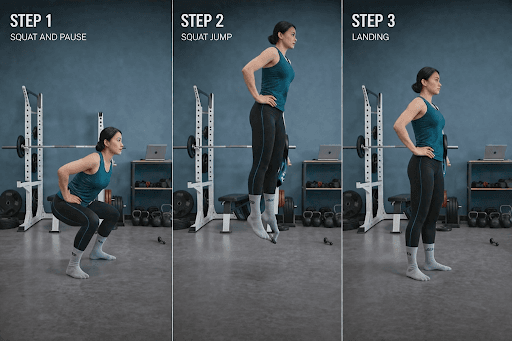
The rapid eccentric loading followed by immediate concentric contraction enables the muscle-tendon unit to store and release elastic energy, resulting in greater jump height than the SJ. The difference between CMJ and SJ height is a key diagnostic metric, indicating how effectively an athlete utilises elastic energy, an ability that is both highly trainable and sensitive to neuromuscular fatigue.
Sports where CMJ is more important to test and improve
The CMJ is the most widely used jump test in athletic monitoring because the stretch-shortening cycle underpins the majority of explosive movements in sport. It is particularly valuable in the following:
Basketball and volleyball. Repeated explosive jumping from dynamic positions is central to both sports. CMJ height is a strong predictor of on-court performance.
Rugby and American football (skill positions). Backs, receivers, and linebackers rely on rapid change of direction and reactive acceleration, movements driven by SSC efficiency. CMJ is a standard component of combine and pre-season testing in both codes.
Soccer. Heading duels, explosive pressing, and vertical challenges all involve reactive lower-body power. CMJ is the most common jump test used in professional soccer for both performance benchmarking and daily wellness tracking.
Sprint running. Ground contact during sprinting is a rapid SSC event. CMJ performance correlates strongly with sprint times, particularly over 10–30 m.
High jump and long jump. The penultimate step and take-off in both events are essentially maximal SSC efforts. CMJ height is a reliable indicator of elastic leg stiffness and reactive strength, both of which are central to jumping event performance.
Gymnastics and martial arts. Tumbling, vaulting, and explosive kicking movements all rely on rapid SSC cycles. CMJ is used both as a talent identification marker and an ongoing training load monitoring tool in elite programmes.
Countermovement jump with arm movement
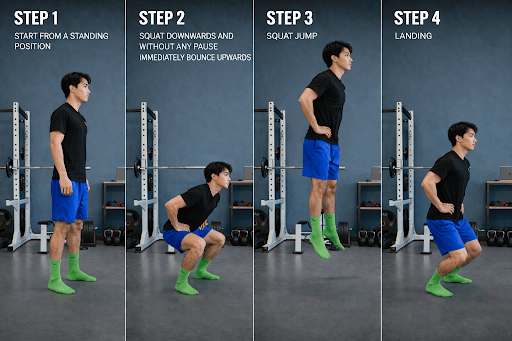
The countermovement jump with arm swing (ACMJ) builds on the CMJ by allowing the athlete to use a natural, unrestricted arm swing throughout the movement.
From a standing position, the athlete performs a rapid downward countermovement while simultaneously sweeping the arms downward and behind the body, then drives upward explosively, throwing the arms upward to augment vertical propulsion.
Arms move freely from the shoulders, with the swing initiated as the countermovement begins and completing at maximum overhead reach at take-off.
This arm action contributes to jump height through two mechanisms: direct upward momentum transfer and a reflex-potentiating effect that increases the rate of force development in the lower limbs. The ACMJ is the most ecologically valid of the three jump tests — it mirrors how athletes actually jump in competition — and the CMJ-to-ACMJ height difference reveals coordinative efficiency and the athlete's ability to integrate whole-body segmental sequencing into a single explosive output.
Sports using ACMJ
The ACMJ is the most sport-specific of the three jump tests for any activity where arms are used freely during explosive movement. It is particularly valuable in the following sports:
Basketball and volleyball. In both sports, athletes jump with full arm involvement on nearly every explosive vertical effort — rebounds, spike approaches, block attempts, and layups all involve arm swing. The ACMJ is the most directly representative lab test of these in-game movements, and CMJ-to-ACMJ gain scores are used in elite programmes to identify athletes with high coordinative efficiency.
High jump and long jump. The arm drive in both jumping events is highly trained and technically critical. A high CMJ-to-ACMJ differential in a field jumper suggests strong proximal-to-distal coordination and good arm-leg timing — qualities that coaches in jumping events actively develop and that are directly measurable through this test.
Sprint running and track and field. Arm mechanics in sprinting directly influence stride rate, trunk stability, and force application. Sprinters with higher ACMJ-to-CMJ ratios tend to demonstrate better arm-leg coordination during acceleration, and the ACMJ is increasingly used as a coordination quality marker in sprint development programmes.
Gymnastics and diving. Whole-body segmental coordination is the defining athletic quality in both disciplines. The ACMJ captures the ability to sequence upper and lower body explosively, making it a useful indicator of coordinative readiness and a sensitive monitoring tool across training blocks where fatigue selectively degrades coordination before raw power.
Soccer and rugby. Aerial duels, throw-ins, and contested headers all involve unrestricted arm use during explosive vertical effort. Field sport athletes who show large ACMJ gains over CMJ typically display better overall athletic coordination, and programmes at elite level use the ACMJ alongside CMJ as part of a standardised jump battery for profiling and readiness tracking.
In contrast, sports where arm use is mechanically constrained during explosive efforts — such as rowing, swimming starts, or bobsled push starts — gain limited diagnostic value from the ACMJ. For those sports, the SJ and CMJ remain the primary tests, and a small CMJ-to-ACMJ gap is unremarkable and not a performance concern.
Using Peak Lines VBT exercises to improve your Vertical Jump Performance
Improvements in vertical jump performance are driven by increases in maximal strength, rate of force development, and movement coordination. The magnitude of training changes varies by jump type, training age, targeted improvement and exercise selection.
Squat Jump (SJ) — expected improvement:
For a trained athlete, a focused 8-week SJ block can realistically produce 4–8 cm of height improvement, with less trained athletes potentially seeing 8–12 cm.
Countermovement Jump (CMJ) — expected improvement:
For a trained athlete, a realistic CMJ height improvement over a focused 8-week block is 3–6 cm, with less trained athletes potentially seeing 6–10 cm.
Arm-Swing CMJ (ACMJ) — expected improvement:
For a trained athlete, a focused 8-week ACMJ block can realistically produce 4–8 cm of height improvement, with less trained athletes potentially seeing 7–12 cm as both strength and coordinative adaptation contribute simultaneously.
The Peak Lines VBT exercises can improve specific vertical jump performance but in practice, improving all three jump types requires a combination of maximal strength, rapid force development, and coordinated force transfer, with exercise selection weighted toward the dominant qualities of the target jump. For example:
- SJ responds most to increases in maximal strength (concentric force dominant) so exercises to prioritise are Front Squat, Back Squat, Hexbar Deadlift.
- CMJ responds to both strength increase and rapid force production (elastic + power dominant) so exercises to prioritise are Power Clean, Front Squat, Back Squat.
- ACMJ adds a technical coordinative component on top of CMJ qualities (elastic + coordination dominant) so exercises to prioritise are Power Clean, Front Squat, Back Squat and Bench Press.
Across all jump types, combining maximal strength (squats), explosive power (power clean), and targeted VBT prescription provides the most effective pathway for improving jump performance, with larger improvements seen in less trained athletes due to greater neuromuscular headroom. We summarise below how each Peak Lines exercise transfers to the specific jump type ranked from highest to lowest relevance.
Highest transfer
Power Clean: Most effective for improving CMJ and ACMJ due to its emphasis on explosive triple extension, rapid force development, and whole-body coordination. Also contributes to SJ through concentric force production from a static start from the floor.
Front Squat: Highly transferable across all jump types. Its upright posture closely matches jumping movement patterns with reliance on both muscular force production and SSC.
Back Squat: Foundational for all jump performance. Greater loading capacity allows for maximal strength developed. This sets the ceiling for force and power output, with strong relevance across all jump types.
Moderate transfer
Hex-Bar Deadlift: Exceptional loading capacity and moderate mechanical similarity to all jump types allows useful development of lower-body force development. The static start position negates SSC utilisation, thus eliciting strong transfer to SJ performance.
Barbell Deadlift: Supports posterior chain strength and concentric force production. Static start with limited SSC utilisation carries more relevance to SJ, however, limited capacity for velocity and knee joint involvement results in lower overall relevance to jump performance.
Lowest transfer
Bench Press: Minimal direct impact on SJ and CMJ. Some indirect relevance to ACMJ through upper-body force contribution during arm swing, but overall low priority for improving jump performance.
Key summary of training for Squat Jump (SJ)
Expected improvement: For a trained athlete, a focused 8-week SJ block can realistically produce 4–8 cm of height improvement, with less trained athletes potentially seeing 8–12 cm.
Primary driver: Maximal concentric force production
Key exercises: Back Squat, Front Squat, Hex-Bar Deadlift
SJ performance is strongly linked to maximal strength, making it highly responsive to strength-focused VBT training. Athletes with lower training age typically show the largest improvements.
Key summary of training for Countermovement Jump (CMJ)
Expected improvement: For a trained athlete, a realistic CMJ height improvement over a focused 8-week block is 3–6 cm, with less trained athletes potentially seeing 6–10 cm.
Primary driver: Stretch-shortening cycle efficiency and rapid force production
Key exercises: Power Clean, Front Squat, Back Squat
CMJ gains depend on both strength and the ability to rapidly utilise elastic energy, making VBT-based power training critical. Linthorne 2001, Claudino et al. 2017.
Key summary of training for Countermovement Jump with Arm Swing (ACMJ)
Expected improvement: For a trained athlete, a focused 8-week ACMJ block can realistically produce 4–8 cm of height improvement, with less trained athletes potentially seeing 7–12 cm as both strength and coordinative adaptation contribute simultaneously.
Primary drivers: Elastic power + whole-body coordination
Key exercises: Power Clean, Front Squat, Back Squat, Bench Press
Early improvements (2–4 cm) can occur through arm swing technique alone, with further gains requiring increased strength and improved force transfer through the kinetic chain. Feltner et al. 1999, Lees et al. 2004.
Why you need to jump test before training
Vertical jump testing, most commonly countermovement jump (CMJ), provides an instant, objective snapshot of an athlete's neuromuscular readiness before training. Explosive jump performance depends on rapid force production, motor unit recruitment and efficient stretch-shortening cycle execution, thus even minor drops in performance can indicate accumulated fatigue or reduced central drive.
Applied practically, a pre-session jump height significantly lower than an athlete's personal best suggests improper recovery and may result in difficulty expressing high levels of force and power during training. This is commonly associated with central nervous system (CNS) fatigue, where the ability to recruit motor units effectively is temporarily impaired. Conversely, stable or improved jump performance indicates the athlete is primed and capable of producing high-quality outputs. By comparing daily results to an individual baseline, coaches and athletes can quickly determine whether to push intensity, maintain the plan, or reduce loading to avoid unnecessary fatigue. Importantly, this approach moves training away from guesswork and toward objective, data-informed decisions.
This makes jump testing a powerful objective tool to inform training intensity. Unlike commonly used methods such as rate of perceived exertion (RPE), which rely on an individual's subjective interpretation of effort during submaximal warm-up sets, jump testing provides a direct measure of neuromuscular output. While RPE can offer useful contextual insight, its accuracy is influenced by factors such as experience, perception, and psychological state, which can limit its reliability when used in isolation. In contrast, jump testing offers a consistent, quantifiable indicator of readiness, allowing for more informed and repeatable training decisions. While jump height alone is useful, greater insight can be gained by tracking additional metrics such as eccentric duration, reactive strength, and force-time characteristics. These help detect more subtle changes in readiness that may not be visible in jump height alone.
In short, pre-session jump testing offers a simple, repeatable way to assess whether an athlete is ready to perform at a high level. When used consistently, it improves training quality, reduces injury risk, and ensures that high-intensity work is performed when the athlete is most capable of benefiting from it.